Leak testing of HVAC and gas installations – methods, tools, and legal requirements

Leak tightness is the foundation of safety and efficiency for every pressurized installation. Leaks not only pose a risk of fire or expensive equipment failure, but also carry severe legal consequences. Installers, building managers, and service technicians operate within a strictly regulated legal environment.
There are two main categories of tools available on the market for leak testing piping systems: traditional aerosol leak detectors or testers (foaming sprays) and advanced electronic detectors. In this article, we will examine both solutions, discuss how they work in practice, and review the specific regulations that mandate regular leak inspections.
1. Gas Installations Under Construction and Energy Law
In the case of natural gas or LPG installations, any leak poses an immediate threat to life. Legislators have approached this matter with extreme rigor.
- Polish Construction Law (Journal of Laws 1994 No. 89 item 414, as amended): Pursuant to Art. 62 sec. 1 pt. 1 let. c, every owner or manager of a building structure is obliged to conduct a periodic inspection AT LEAST ONCE A YEAR. This inspection includes checking the technical condition of gas installations and chimney flues. During such a technical inspection, an authorized person must conclusively verify the leak tightness of the entire visible gas installation – from the main shut-off valve, through the gas meter, threads, and joints, all the way to the gas-consuming appliances themselves (boilers, stoves).
- Polish Energy Law (Journal of Laws 1997 No. 54 item 348, as amended): Art. 51 sec. 1 of the Energy Law clearly specifies that gas appliances and installations must be operated in a manner that ensures the safety of operators and the surrounding environment. Responsibility for maintaining this condition falls directly on the user/owner, but the service technician performing the technical inspection bears the duty of thorough verification after every repair or service check.
2. HVAC Installations (Air Conditioning, Heat Pumps, Refrigeration) and the F-Gas Act
In the refrigeration industry, a leak means not only a drop in system efficiency and seizing compressors, but above all, the emission of greenhouse gases, which is strictly penalized.
Act on Substances that Deplete the Ozone Layer and on Certain Fluorinated Greenhouse Gases (Journal of Laws 2015 item 881, as amended) and the EU F-Gas Regulation: These regulations impose strict obligations on equipment operators (owners) that directly involve certified installers (holding an F-gas certificate).
- Mandatory inspections: Equipment containing fluorinated greenhouse gases in quantities of 5 tonnes of $\text{CO}_2$ equivalent or more (or 10 tonnes or more for hermetically sealed systems) is subject to mandatory periodic leak checks (most commonly once every 12 months, and for larger systems even once every 6 or 3 months).
- Entry in the Central Register of Operators (CRO): Every intervention, leak test, leak detection, and subsequent repair must be recorded in the Central Register of Operators (CRO). Concealing a leak or failing to carry out inspections risks financial penalties reaching tens of thousands of zlotys (imposed by the Voivodeship Inspectorate for Environmental Protection – WIOŚ).
3. What and How to Test? Aerosols vs. Electronics
Now that we know why we must test the leak tightness of our installations, let us move on to how to do it in practice to meet legal standards and ensure 100% diagnostic certainty.
Aerosol Leak Detectors – Reliable Visual Verification
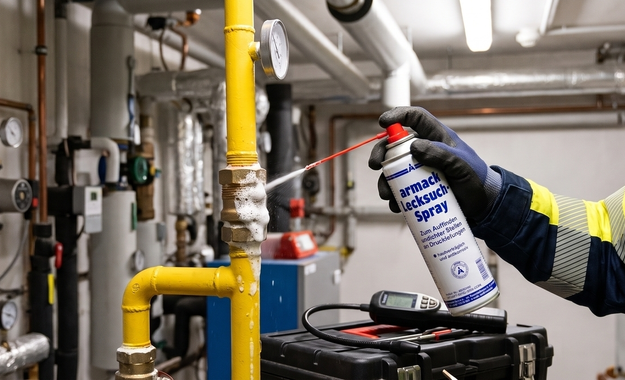
Aerosol leak detectors (so-called "foams") are an absolute staple. In accordance with best installation practices described in industry standards and technical literature, confirming an installation repair must be based on a visual foam test (e.g., after pressurizing the system with nitrogen).
-
armack Aerosol Leak Detector 400ml – a classic, efficient formulation based on safe chemical compounds.
-
armack Leak Tester with 360° Valve in Aerosol 400ml – allows application in any position (even upside down). This version of the leak detector makes it easier to check threads and unions hidden in tight shafts or hard-to-reach places inside heating appliances.
Why use an aerosol leak detector?
- Emerging bubbles—the proverbial "bubbling"—pinpoint a leak down to the millimeter, for example, on a press-fit or compression joint.
- In accordance with refrigeration procedures, after brazing copper pipes (e.g., during VRF or split system installation), the system is charged with nitrogen (often at pressures greater than 40 bar). Electronic detectors will not work here—the only reliable method for inspecting joints is liberally spraying them with a leak tester.
Electronic Leak Detectors (Sniffers) – Advanced Sensitivity, Yet Targeted
To meet the requirements of the F-Gas Act, refrigeration and HVAC installers must rely on electronic detectors. These devices feature extremely high sensitivity (capable of detecting a loss on the order of 3–5 grams of gas per year). They operate like an electronic "nose"—drawing in ambient air through a probe and analyzing it for molecules of a specific gas.
However, it is worth debunking a very popular myth right at the outset: there is no single, simply constructed detector that will detect every type of gas in the world. Device selection must be strictly tailored to the installer's business profile. This is because natural gas molecules differ fundamentally from the molecules of synthetic refrigerants or natural gases.
Classification by type of gas detected:
- Combustible gas detectors: Used primarily in heating engineering and residential installations. They react to methane (natural gas) and propane-butane (LPG).
- Refrigerant detectors (F-gases): Designed to detect hydrofluorocarbons (HFCs, e.g., R32, R410A, R134a) and modern HFO refrigerants (e.g., R1234ze(E), R1234yf, R1233zd).
- Natural gas detectors in HVAC: Due to environmental regulations, propane (R290), propylene (R1270), or isobutane (R600a) are now widely used in heat pumps. A standard F-gas detector will generally not detect them—a device dedicated specifically to R290 is required.
Technological differentiation (sensor types): The operating characteristics of an electronic tester depend directly on the sensor installed inside:
- Heated diode / semiconductor sensors: The most common on the market. They require a "warm-up" period before operation. They are very sensitive, but the sensor burns out and degrades over time, requiring periodic replacement.
- Infrared (IR) sensors: A more modern, higher-cost technology. Their major advantage is a long service life (up to 10 years) and the fact that they are significantly less prone to false alarms triggered by temperature fluctuations, humidity, or lubricant vapors.
The market offers a full spectrum of prices and technologies—from proven, certified devices such as the Value VML-2 or Testo 316-3 (ideal for F-gas audits), through equipment capable of handling both F-gases and R290 propane (e.g., Testo 514), to modern infrared detectors (e.g., Elitech Inframate S). Some manufacturers have approached the challenge of versatility slightly differently by creating units with easily interchangeable sensor heads for different gases (e.g., Refco Tritector).
Advantages of electronic detectors:
- Speed of operation: They allow rapid "scanning" of many meters of insulated piping or extensive condenser fins.
- Micro-sensitivity: They pick up vapors long before a leak becomes visible to the naked eye or affects system pressure.
- Legal compliance documentation: Owning a verified/calibrated device is often a formal requirement for companies holding an F-gas certificate.
Disadvantages and limitations:
- False alarms: They require operator skill. Drafts from a fan, high ambient humidity, or even vapors from certain cleaners or lubricants can fool simpler sensors, triggering an alarm beep where the system is completely tight.
- Operating costs: The devices require charging/batteries, regular calibration, and costly sensor replacements.
- Useless during nitrogen pressure tests: An electronic detector searches only for a specific chemical compound. During the pressure test critical to refrigeration installers (when pure nitrogen is pumped into the system), no electronic device will indicate a leak.
Does Electronics Outperform Traditional Aerosol Leak Testers in Practice?
In a professional refrigeration service company, electronic equipment and aerosol formulations do not compete with each other—they complement one another. An exemplary diagnosis that complies with both regulations and best installation practices means that an installer's service van will carry both an aerosol leak detector and an electronic tester. Conversations with installers lead to one clear takeaway: always test with an aerosol preparation first. If pressure drops or equipment error codes persist, bring out the electronics.
Author: Adam Kopeć