Guide to Soft Soldering Fluxes: An Overview of Products and Professional Applications

Soft Soldering Flux Guide: Product Overview and Professional Applications
Soft soldering—joining metals at working temperatures below 450°C—is a joining process used across numerous industrial and trade sectors: from roofing and architectural sheet metal work to plumbing installations, automotive radiator repair, electronics, metal art, and stained glass manufacturing. Alongside the appropriate solder, selecting the correct flux is critical to achieving a strong, permanent joint. Its primary functions are to remove metal oxides from the surfaces, improve the flow and wetting characteristics of the solder, and protect the surfaces from re-oxidation during heating.
Chemical classification – understanding DIN EN 29454-1 (ISO 9454-1)
Soldering fluxes are categorized according to standardized normative criteria. The DIN EN 29454-1 standard (equivalent to ISO 9454-1) classifies fluxes based on their chemical composition. This designation system is highly precise, taking into account the flux type, chemical base, activator type, and physical form (form of supply) of the product. Regarding physical form, the letter A represents liquid (e.g., our armack ZWN soldering fluid, DIN EN 29454-1, 3.2.2 A), B represents solid, and C represents paste (e.g., our pastes designated as 3.1.1 C).
Standard-based classification is only the starting point, however. A flux's practical performance and suitability must be determined through specific testing procedures. While standard laboratory testing cannot guarantee absolute reliability under every extreme workshop condition, it provides a reliable assessment for a key question: Must the flux residues be strictly removed after soldering? Understanding this distinction prevents subsequent corrosion issues on soldered components.
Comparison of classifications
Comparison between the DIN EN 29454-1 classification and the obsolete German DIN 8511 standard:
- Fluxes with corrosive residues when soldering heavy metals: e.g., F-SW-11 (corresponding to 3.2.2); F-SW-12 (corresponding to 3.1.1); F-SW-13 (corresponding to 3.2.1).
- Fluxes with residues corrosive under certain conditions: e.g., F-SW-21 (corresponding to 3.1.1 or 1.1.2); F-SW-26 (corresponding to 2.1.2 or 2.2.2).
- Fluxes with non-corrosive residues: e.g., F-SW-31 (corresponding to 1.1.1); F-SW-32 (corresponding to 1.1.3); F-SW-33 (corresponding to 1.2.3); F-SW-34 (corresponding to 2.2.3).
The DIN 8511 standard is obsolete and was withdrawn in 1996. However, legacy flux designations such as F-SW 32 or F-SW 26 remain commonly used in practice.
How to read classification 3.2.2 A according to DIN EN 29454-1 using armack ZWN soldering fluid as an example:
- 3: inorganic
- 2: acids
- 2: other acids
- A: liquid
With this foundational knowledge, let us now look at our individual products, categorized by their application areas and properties. The armack range covers a broad selection of fluxes for different materials and operating conditions. Categorizations such as "roofing flux," "plumbing flux," or "automotive flux" are often simplified classifications. In practice, these same products prove highly effective across industries that may seem unrelated at first glance.
Liquids, gels, or pastes – which flux form is right?
The physical form of the flux significantly impacts ease of use and application accuracy. Our product range includes three main physical forms:
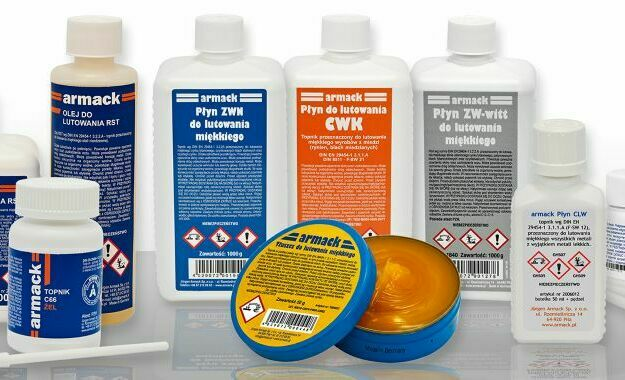
- Liquids and soldering fluids: Including CWK, ZWN, ZWS, ZW-witt, CLW, and RST soldering oil. Their advantages are high fluidity and rapid penetration into capillary gaps. They spread quickly, making them ideal for soldering large sheet metal surfaces.
- Gels: Notably products like C66 or the X32 flux pen. Their viscous consistency prevents run-off—for example, when soldering vertical pipe sections—enabling precise, targeted application.
- Pastes and soldering greases: This group includes soft soldering grease as well as solder-bearing pastes such as LF (e.g., LF No. 3) and WSN (in variants 25, 40, and 60). These are especially practical for soldering copper pipes and tinning vehicle bodies, as they adhere extremely well to the heated component.
One flux, many industries – versatile applications
A particularly striking example of cross-industry flux application can be found in products traditionally associated with roofing and sheet metal work: ZWS, ZWN, CWK, and ZW-witt. In architectural sheet metal work, they are used to solder galvanized steel sheets, zinc sheets, and titanium zinc.
A prime example of a product extending beyond a single trade is CWK soldering fluid. Roofers and sheet metal workers frequently use it for soldering copper gutters. At the same time, it is a staple for automotive electricians and companies manufacturing or repairing radiators. CWK effectively removes patina and contaminants from aged conductors or brass radiator fins.
ZWN is equally versatile. Used in roofing and plumbing for soldering galvanized sheets, it is also ideal for other applications requiring soft soldering of thin-walled steel components. Similar versatility is offered by paste-form soldering grease and C66 flux gel: both products support work in metal art, roof flashings, heating installations, and mechanical engineering.
Overview of the most popular products
Selecting the appropriate flux primarily depends on the base material.
1. Copper and brass: Installations, radiators, and metal art
- Soldering fluid CLW / Soldering fluid CWK: Excellent for copper. The wide range of copper flux applications—from Tiffany stained glass craft to industrial uses—is discussed in detail in our article "Applications of Copper Soldering Liquids Across Various Industries."
- Solder paste LF No. 3: A proven standard product for installers. Ideal for soft soldering copper pipes in drinking water and heating systems, as well as pre-tinning connection ends in electrical engineering.
- Flux gel C66: Highly popular in heating installation and metal design due to its non-drip consistency.
2. Steel sheets, galvanized sheets, and titanium zinc: Roofing and structural work
Sheet metal and roofing work require highly active, acid-containing fluxes capable of handling tough protective layers. Liquid fluxes, commonly referred to as soldering fluids, dominate this category:
- Soldering fluid ZWN and Soldering fluid ZWS: Classic soldering fluids primarily used for soft soldering galvanized steel sheets, zinc sheets, and various thin-walled steel components.
- Soldering fluid ZW-witt: A product with properties similar to ZWN and ZWS, formulated specifically to optimize the soft soldering of titanium zinc.
The secret behind the effectiveness of soldering fluids
Products like ZWN, ZWS, and ZW-witt belong to the acid-containing flux category. Their high effectiveness is based on their hydrochloric acid content. Although present in low concentrations and quantities, hydrochloric acid plays a vital role: it rapidly and aggressively dissolves oxide layers, significantly improves wetting and solder flow, and enables durable soldered joints on demanding surfaces such as galvanized sheet metal or titanium zinc.
Although these products are preferred fluxes for roofing applications, ZWN in particular has proven invaluable in workshops joining thin steel components—for instance, soldered watering cans made of galvanized sheet steel.
3. Tinning and bodywork
WSN pastes in variants 25, 40, and 60: Essential solder-bearing pastes for soft soldering and body tinning in automotive restoration/manufacturing, also highly valued in electrical engineering. To learn more about tinning, read our article "Body Tinning Is Making a Comeback: Why Replacing Body Filler Is Worth It and How to Do It Right."
4. Specialized applications: Stainless steel, lead soldering, and electronics
- Soldering oil RST: Formulated specifically for soft soldering stainless steel. Due to its dense chromium oxide layer, stainless steel requires a highly effective, tailored flux. For more details, see our article "Soft Soldering Stainless Steel – What You Need to Know About This Joining Process."
- Soldering oil PB23: Designed specifically for soft soldering lead in metal art and construction.
- STANNOL X32 flux pen and block rosin (colophony): Products for precision electronic soldering that minimize the risk of short circuits and corrosion on sensitive circuitry.
General guidelines: Application and post-soldering procedures
Even a chemically optimal flux will fail if applied incorrectly or if residues are handled improperly after completing the job. Based on the technical data sheets for our products—including ZWN and CWK soldering fluids, LF No. 3 solder paste, and RST soldering oil—we emphasize the essential rules of professional soldering:
Preparation and application: The surface to be soldered must be thoroughly cleaned of oil and dust. In copper plumbing, fittings and pipe ends must be cleaned using non-metallic cleaning pads. Apply the flux in a targeted and economical manner, preferably using brushes designed for soldering fluids and pastes.
- Mandatory post-solder cleaning: This step is critical. Flux residues remaining on pipes, cables, circuit boards, or sheet metal after soldering must be thoroughly removed using a damp cloth or a suitable solvent such as isopropyl alcohol (IPA).
- System flushing: When fluxes are used in potable water and heating systems (e.g., LF No. 3 solder paste), the system must be thoroughly flushed with water in compliance with relevant hygiene regulations.
Why is this so important? Thorough removal of flux residues prevents the formation of green verdigris deposits caused by chemical salt reactions with copper. At the same time, it significantly reduces the risk of destructive pitting corrosion on soldered components.
- Tools and workplace safety: Always maintain the soldering tip, using sal ammoniac (ammonium chloride blocks) to clean it. This helps prevent inclusions in the soldered joint and ensures a stable operating temperature.
All fluxes are chemical products intended for professional use. Store them out of reach of children and in clearly labeled packaging.
Summary
When selecting a soft soldering flux, do not rely solely on labels like "for roofers" or "for automotive." Instead, the decisive factors are the base material being processed and the physical consistency best suited to working conditions—liquid, gel, or paste. Making an informed flux choice ensures joint strength, aesthetic appearance, and work efficiency.
Explore our complete range of fluxes in our online shop and select the products that best meet the technical demands of your workshop!