Guide to Fluxes for Soft Soldering: Product Overview and Professional Applications

Guide to Brazing Fluxes for HVACR: Product Overview and Professional Applications
In the world of HVACR (Heating, Ventilation, Air Conditioning, and Refrigeration) and precision metal joining, brazing flux is a key element that ensures the longevity and reliability of every installation. Choosing the right product not only affects the quality of the brazed joint, but also safety and work efficiency. In this guide, you will find practical tips to help you make an informed choice tailored to your needs. Learn about the types of fluxes available, how they differ, and how to apply them to avoid mistakes.
In this article, you will learn:
- What brazing flux is and what functions it performs
- The differences between brazing and soft soldering fluxes
- Which types of flux are available on the market and for which metals they are used
- What to consider when selecting a flux for HVAC and refrigeration systems
- How to safely store and apply fluxes in practice
- Which products are most commonly chosen and what sets them apart
What Are Brazing Fluxes?
A brazing flux is a specialized mixture of chemical compounds (mostly based on borates and fluorides) used when joining metals at temperatures above 450 °C. To allow the filler metal to flow freely over the material surface and form a uniform, permanent joint, the flux must fulfill several critical tasks:
-
Dissolve and remove the oxide layer from the metal surface during heating
-
Protect the surface from atmospheric oxygen and re-oxidation
-
Improve the wetting action of the filler metal and its adhesion to the base metal
-
Stabilize the brazing process at high temperatures
In HVAC systems, this plays a fundamental role. Joints in refrigeration or air conditioning systems must withstand high operating pressures, sudden temperature fluctuations, and long-term continuous operation. A well-selected flux enables the creation of a homogenous brazed seam even under demanding industrial conditions, minimizing the risk of leaks and costly failures.
Before deciding on a specific product, keep these essential facts in mind:
- Chemical composition matters – it must be tailored to the specific metals (copper, brass, stainless steel, or aluminum).
- Various application forms – fluxes are available as pastes, powders, gels, or as a convenient coating on the brazing rod.
- Work hygiene – the final quality of the joint depends not only on applying the flux, but also on the proper removal of its residues after completing the brazing process.
Differences Between Brazing and Soft Soldering Fluxes
Brazing fluxes and soft soldering fluxes differ primarily in their operating temperatures and chemical compositions. Brazing fluxes are designed for joining metals at temperatures typically above 450 °C, whereas soft soldering fluxes operate in lower temperature ranges.
The composition of brazing fluxes is usually based on borates and fluorides (e.g., fluoroborates, potassium fluorometallates), which effectively remove oxides from metal surfaces and remain active at high temperatures. Soft soldering fluxes are mixtures that often contain zinc chloride, ammonium chloride, hydrochloric acid, or rosin and halides.
Types of Brazing Fluxes on the Market
The choice of flux should always depend on the base material and the filler metal used. In practice, several main categories of fluxes are distinguished:
- Fluxes for brazing copper and its alloys
- Fluxes for brazing steel
- Fluxes for brazing aluminum
- Universal fluxes for selected groups of metals
Each of these groups has distinct properties and limitations.
Fluxes for Brazing Copper
Brazing fluxes for copper are widely used in HVAC systems. In practice:
- For copper-phosphorus filler metals (CuP or CuPAg) and copper-to-copper joints, no external flux is required.
- For high-silver content filler metals, or CuP/CuPAg filler metals when joining copper to brass, the use of a Class FH10 flux according to DIN EN 1045 is required (e.g., armack HS brazing paste). Fluxes in this class ensure effective oxide removal and stable filler metal flow.
Fluxes for Brazing Steel
Fluxes for brazing steel with bare silver brazing alloys are used when joining carbon steel, stainless steel, cemented carbides, and dissimilar joints such as stainless steel to copper. They are available in various activity classes:
- Class FH10 fluxes – for stainless steels and mild steel sheet
- Class FH12 fluxes – for stainless steels, acid-resistant steels, and hard-to-braze metals
- Class FH20 and FH21 fluxes – for carbon/mild steels and copper alloys where the filler metal is typically a brass brazing alloy
- Fluxes with enhanced heat resistance – for prolonged heating cycles and high temperatures; they ensure uniform filler metal flow and high joint quality
Fluxes for Brazing Aluminum
Aluminum requires specialized fluxes based on fluorometallates. These operate at temperatures of approximately 570–610 °C and are used exclusively with Al-Si filler metals. The residues of such fluxes are highly corrosive and must be thoroughly removed after brazing. In this product group, powders and pastes are available for aluminum brazing.
Universal Fluxes – When Is Their Use Worthwhile?
Universal fluxes prove effective when brazing copper, brass, and carbon steel, but they do not replace specialized fluxes for aluminum or stainless steel. In HVAC service work, they can be a practical solution, provided they fall within the appropriate temperature and material ranges.
Selecting a Brazing Flux – What to Look For?
Selecting the right brazing flux requires considering several key parameters. Above all, it depends on the type of material you are working with, the brazing temperature, and the specific requirements of the installation. A well-chosen flux ensures not only joint durability, but also safety and working convenience.
Key aspects to consider:
- Chemical composition of the flux and its compatibility with the base material (e.g., copper, brass, steel, aluminum)
- Activity range of the flux – this should overlap with the melting range of the filler metal used
- Form of application (paste, powder, gel, flux-coated rod, flux-cored wire)
- Intended purpose – whether the flux is designed for HVAC/refrigeration systems, general applications, or industrial use
- Safety and cleaning requirements (hygroscopicity, corrosivity, ease of washing off)
Technical Parameters of Fluxes
Every brazing flux is characterized by specific technical parameters: active temperature range, viscosity, duration of action at temperature, chemical composition, and the type of residues left after brazing. It is important to know whether residues can be easily removed with water or require more intensive cleaning. In HVAC systems, effective yet easy-to-wash-off fluxes should be selected to minimize corrosion risks.
Intended Purpose and Material Compatibility
The key to a durable and leak-tight joint is matching the flux to the specific metal and filler metal. In HVAC systems, where copper, stainless steel, and brass are most commonly joined, fluxes for silver brazing alloys are the standard. However, an important exception applies: when joining copper to copper (using CuP or CuPAg filler metals), flux is generally not required at all.
Fluxes for HVAC Systems
In HVAC and refrigeration systems, not only mechanical joint strength matters, but also resistance to environmental influences such as moisture or temperature fluctuations.
In practice:
- Use highly active fluxes whose residues are easy to wash off.
- Prevent flux from entering the interior of the system (internal contamination must be avoided).
- Purge the system with dry nitrogen when brazing copper to reduce internal oxidation inside the pipes.
Practical Application of Fluxes in the HVAC Industry and Industrial Plants
Choosing the right flux in the HVAC industry (air conditioning, refrigeration) and industrial settings is crucial to ensuring leak tightness and durability in high-pressure systems. Selection depends primarily on the base materials being joined and the filler metal used. In practice, fluxes are used both in new installations and for repairing or upgrading existing systems.
Essential rules for safe and effective flux application:
- Thoroughly clean and degrease the joint surfaces.
- Apply a thin, uniform layer of flux only to areas where the filler metal is intended to flow.
- Do not overheat the flux (once burned, it loses its activity).
- Remove flux residues after completing the brazing process (for most fluxes, warm water and a brush are sufficient; aluminum fluxes may require more thorough cleaning).
- In refrigeration systems, use nitrogen purging inside the pipes during heating.
Safety and Storage of Fluxes
Brazing fluxes should be stored in a cool, dry place away from heat and moisture sources. It is essential that packaging remains tightly sealed to prevent clumping and loss of properties (some brazing fluxes are hygroscopic).
During work:
- Wear protective gloves and eye protection.
- Ensure good workplace ventilation.
- Avoid skin and eye contact with flux, as well as breathing in fumes.
- Do not mix different fluxes or dilute them unless recommended by the manufacturer.
- Observe the expiration date and disposal guidelines.
- Toxic fumes are generated during brazing – always ensure adequate ventilation.
Product Overview – Market Offering Analysis
Selecting the form of brazing flux depends on user convenience and specific working conditions:
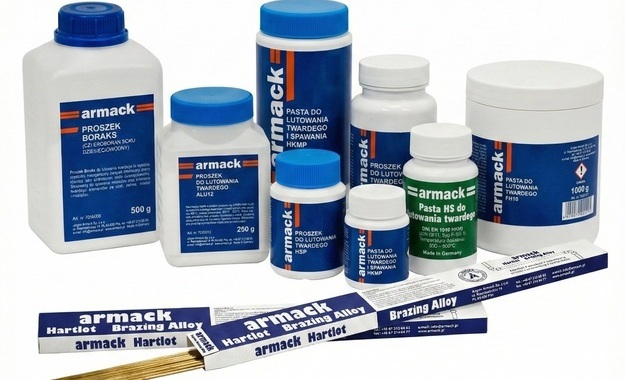
- Paste: Most precise. Applied with a brush to the pipe end (exterior only!). Allows exact coverage of the joint area.
- Powder: More economical, but harder to apply. Typically, the heated brazing rod is dipped into the powder.
- Coating (flux-coated rods): The flux is applied directly onto the brazing rod. Very convenient...